Reading the marks on gold and silver
Hallmarks guide: Irish, UK and European marks
A hallmark is a row of small stamps applied by an independent assay office after testing the metal. The most useful stamp is the fineness number: 375, 585, 750 and 916 on gold mean 9ct, 14ct, 18ct and 22ct; 925 on silver means sterling. The other stamps tell you who made the piece, which office tested it and, often, the year. Find the number, and the price per gram follows directly from it.
The four parts of a hallmark
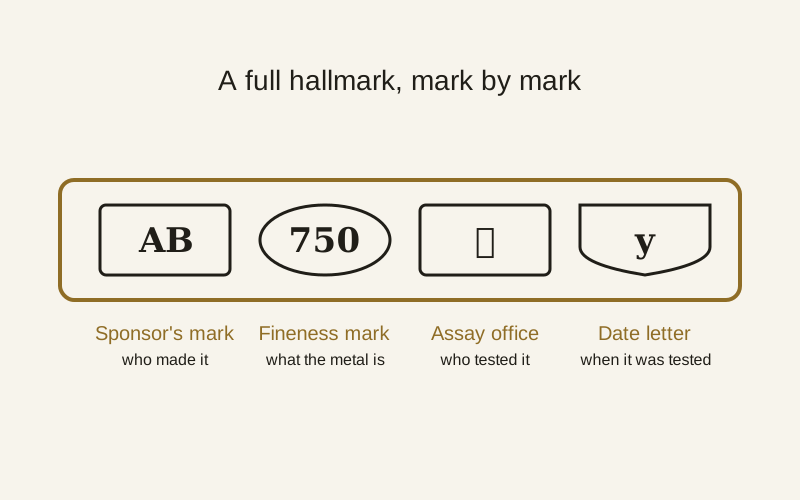
- Sponsor's or maker's mark. Initials of the firm that submitted the piece, in a shaped outline. Identifies the maker; does not affect metal value.
- Fineness mark. The standard of the metal, as a number in parts per thousand (modern) or a traditional symbol (older pieces: a crown for gold, a lion passant for sterling silver in Britain). This is the stamp that sets the price.
- Assay office mark. The symbol of the office that tested the piece.
- Date letter. Optional on modern pieces, standard on older ones. A letter whose font and shield change each cycle, decoded from the office's tables.
Gold fineness numbers
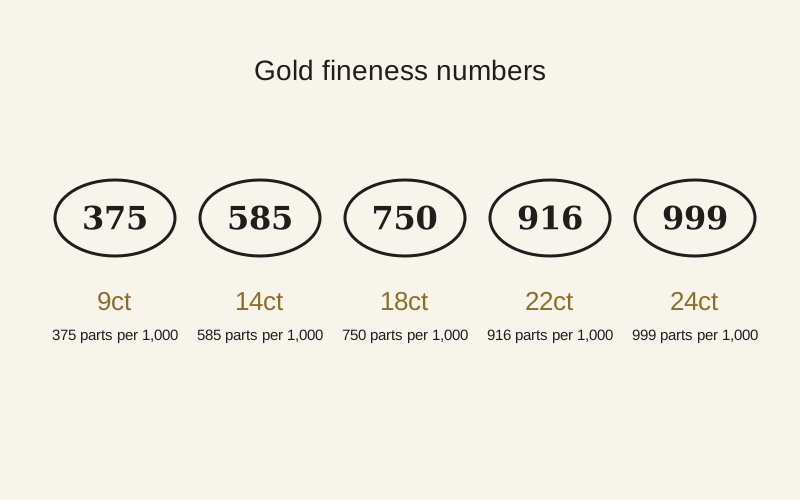
| Number | Carat | Gold content | Also seen as |
|---|---|---|---|
| 375 | 9ct | 37.5% | 9ct, 9K, .375 |
| 417 | 10ct | 41.7% | 10K (American) |
| 585 | 14ct | 58.5% | 14K, 583 (older Russian and Eastern European) |
| 750 | 18ct | 75.0% | 18ct, 18K, .750 |
| 916 | 22ct | 91.6% | 22K, 917 |
| 999 | 24ct | 99.9% | 24K, 9999, fine gold |
9ct is the everyday standard in Ireland and Britain, 14ct in America and much of Europe, 18ct for better jewellery everywhere, 22ct across South Asia and the Middle East. Each number maps to a row on our price list:
| Grade | Hallmark | We pay per gram |
|---|---|---|
| 9ct gold | 375 | €34.91$39.64£29.84 |
| 14ct gold | 585 | €56.54$64.20£48.32 |
| 18ct gold | 750 | €75.14$85.32£64.22 |
| 22ct gold | 916 | €91.77$104.20£78.43 |
| 24ct gold | 999 | €100.09$113.65£85.54 |
Shown in USD for reference at €1 = $1.1355 (ECB reference rate, 30 Sep 2026, 15:00). We pay in euro by bank transfer.
Shown in GBP for reference at €1 = £0.8546 (ECB reference rate, 30 Sep 2026, 15:00). We pay in euro by bank transfer.
Irish hallmarks
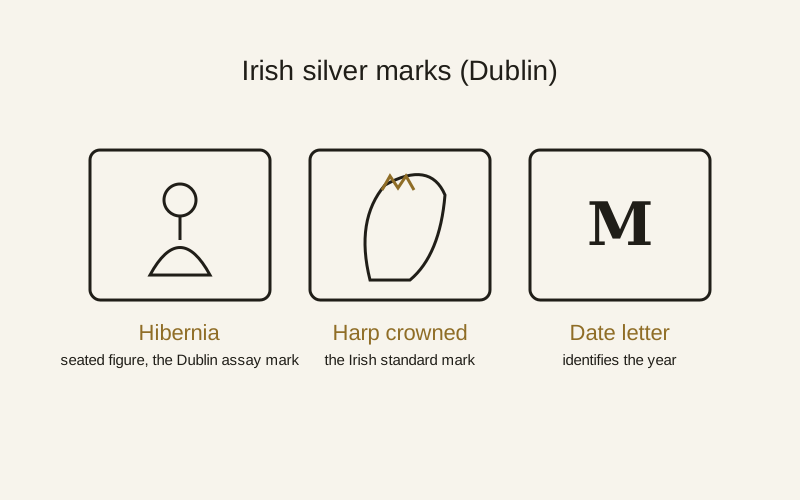
Ireland has one assay office, in Dublin, established by charter in 1637 and still working from Dublin Castle. Its mark is Hibernia, a seated female figure, applied to gold, silver and platinum. On sterling silver the traditional standard mark is the harp crowned; modern pieces carry the 925 number as well or instead. Irish gold carries the fineness number with Hibernia, and older pieces add a crown for higher standards. Dublin date letters run in cycles and are the key to dating Georgian and Victorian Irish silver, which can be worth several times its metal. Provincial Irish silver from Cork and Limerick was never assayed in Dublin and is marked STERLING or STERG with a maker's mark; it is scarce and collectable.
UK hallmarks
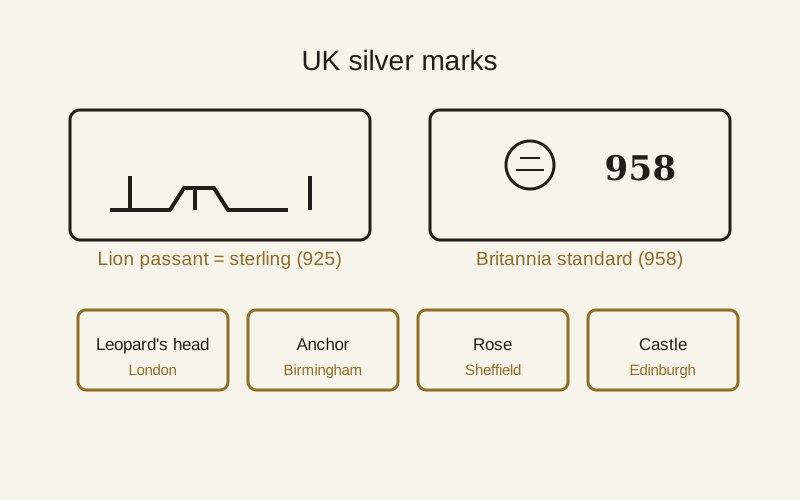
A modern British hallmark has three compulsory parts: sponsor's mark, fineness number and assay office mark. The four surviving offices are London (leopard's head), Birmingham (anchor), Sheffield (rose; a crown before 1975) and Edinburgh (three-towered castle). Closed offices you will still meet on old pieces include Chester (three wheatsheaves and a sword), Glasgow (a tree, fish and bell) and Dublin's Hibernia on pieces sent across before independence.
Traditional standard marks still appear alongside or instead of the number: the lion passant (a walking lion) for sterling silver, the figure of Britannia for 958 silver, a crown on gold, and an orb on platinum. Most British pieces also carry a date letter. Commemorative marks turn up too: the sovereign's head for the 1953 coronation and the 1977, 2002, 2012 and 2022 jubilees, and the Millennium mark for 1999 and 2000.
European marks
- Common Control Mark. A balance scale with the fineness number inside, used by countries in the international Hallmarking Convention, which includes Ireland and the UK. A piece with this mark is recognised as hallmarked here whatever country struck it.
- France. An eagle's head for 18ct gold, a Minerva head for silver (first standard 950, second 800), a dog's head for platinum, and an owl or swan on imported or unmarked goods. French gold is almost always 18ct.
- Italy. A star, a number and two letters in a lozenge, such as *750 or 1AR: the star marks Italian manufacture, the number is the maker's registration and the letters the province (AR Arezzo, VI Vicenza, AL Alessandria). Fineness is a separate 750 or 925 stamp. Italian chains are usually 18ct.
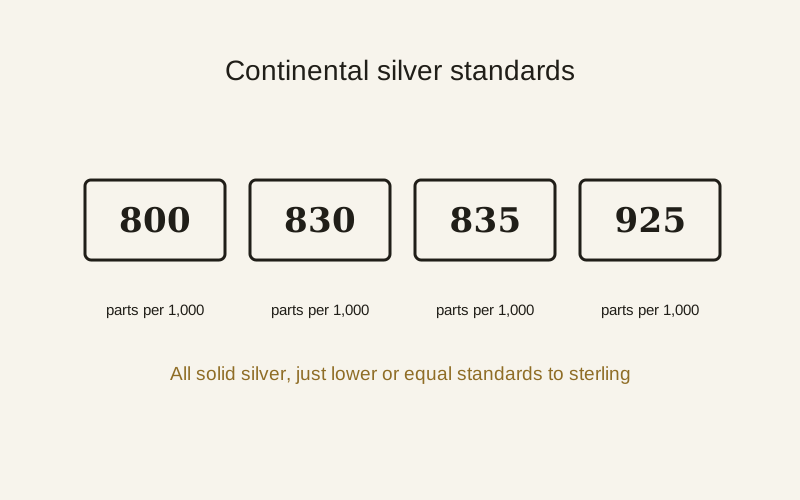
- Germany. A crescent moon and crown with a fineness number (800, 835, 925) on silver since 1888; gold carries the number alone, and 333 (8ct) is common on German pieces: a third gold, priced on its tested content.
- Elsewhere. Portugal uses a rooster or a deer's head; Spain a star; Switzerland a St Bernard's head on watch cases; Russia the kokoshnik (a woman's head in profile) with 56 (14ct) or 84 zolotniki (875 silver); the United States has no national hallmark, only maker's stamps such as 14K or STERLING.
Marks that mean it is not solid gold or silver
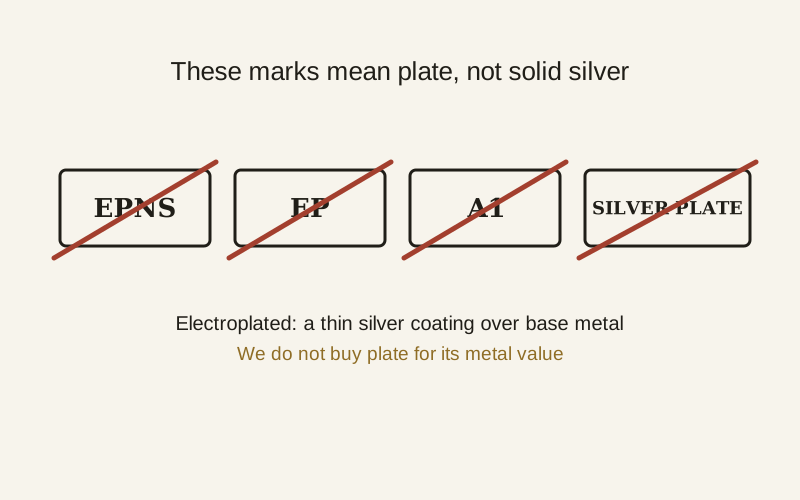
| Mark | Means |
|---|---|
| EPNS, EP, EPBM, A1, “silver plated” | Electroplated base metal. No silver value. |
| Nickel silver, German silver, alpaca, Sheffield plate (as a maker's description) | Alloys containing no silver, or a thin fused layer. |
| GP, GEP, HGE, “gold plated”, “vermeil” | Gold plating over base metal or silver. Priced as the base metal, not as gold. |
| RG, RGP, GF, 1/20 12K, 1/10 14K | Rolled gold or gold filled: a bonded layer, a fraction of the weight. Not solid gold. |
| 925 on a very light, magnetic or pink-worn piece | Possibly a false stamp. Testing decides. |
Photographing a mark
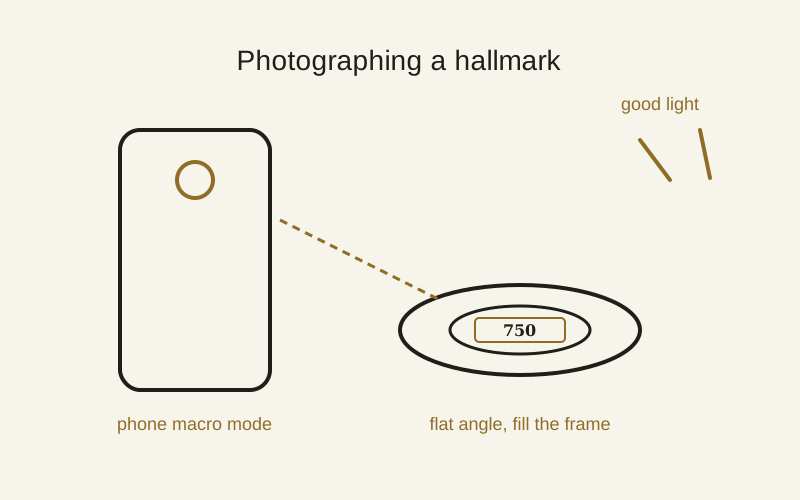
A sharp photo of the marks, sent on WhatsApp, tells us most of what we need before you post anything. Use your phone's macro or zoom, good daylight, hold the mark flat to the camera and fill the frame. The swipe-through version of this guide, with the same pictures, is at hallmarks explained with pictures.
When the marks are missing, worn or wrong
Marks wear off old rings, vanish when a piece is resized, and are sometimes false. That is why we test every item by XRF, marked or not, and pay on what the metal actually is. If you cannot find a mark, do not assume the piece is worthless: weigh it, and let the test decide. Our calculator page takes it from there.
Questions people ask
What do 375, 585, 750 and 916 mean on gold?
Parts of gold per thousand. 375 is 9ct (37.5 percent gold), 585 is 14ct, 750 is 18ct, 916 is 22ct and 999 is 24ct fine gold. The number sets the price per gram directly.
What does 925 mean?
Sterling silver: 925 parts silver per thousand, 92.5 percent. 958 is Britannia silver, 999 is fine silver, and 800, 830 and 835 are continental silver standards. All are solid silver with real metal value.
Is a piece with no hallmark worth anything?
Yes, if the metal is real. A hallmark is evidence of fineness, not the source of value. Unmarked pieces are tested by XRF and paid at the rate for whatever fineness they actually are. Older, resized and imported jewellery is often unmarked.
Can hallmarks be faked?
Occasionally, which is why a serious buyer tests every piece regardless of its marks. A stamped 750 on a base-metal chain is not gold. XRF testing reads the metal itself, not the stamp.
What is the difference between a hallmark and a maker's stamp?
A hallmark is applied by an independent assay office after testing the metal. A maker's stamp such as 18K or 925 is the manufacturer's own claim. Most jewellery sold worldwide carries only a maker's stamp, which is usually honest but is not independently verified.
How can I tell what year an Irish or British piece was made?
From the date letter, a single letter in a shaped shield whose style changes with each cycle. Each assay office keeps published tables; the shield shape and letter style together give the year. It matters most for antique silver, where age adds value beyond the metal.
Ready to sell?
Check the net price per gram for your grade first, then request a free insured postal pack. Every item is tested on camera, the offer is itemised, and anything you decline comes back free.