Buyer programme / How to check metal
Counter calculatorBuyer programme · before you buy
How to check if you have real gold or silver.
Three checks, in this order, on every piece: read the hallmark, try the magnet, then the acid. You do not need to be a jeweller. The marks and the magnet do most of the work and the acid settles the rest.
If any one check says no, hand it back.
A piece that turns out not to be gold or silver is not paid for and the loss is yours. Not buying costs nothing.
Look for the hallmark
A hallmark is a tiny stamp that says what the metal is. Find it with the loupe, match it to the lists below, and you know which row of the calculator to read. No hallmark, or a mark from the red list, and the answer is already no.
Where to look
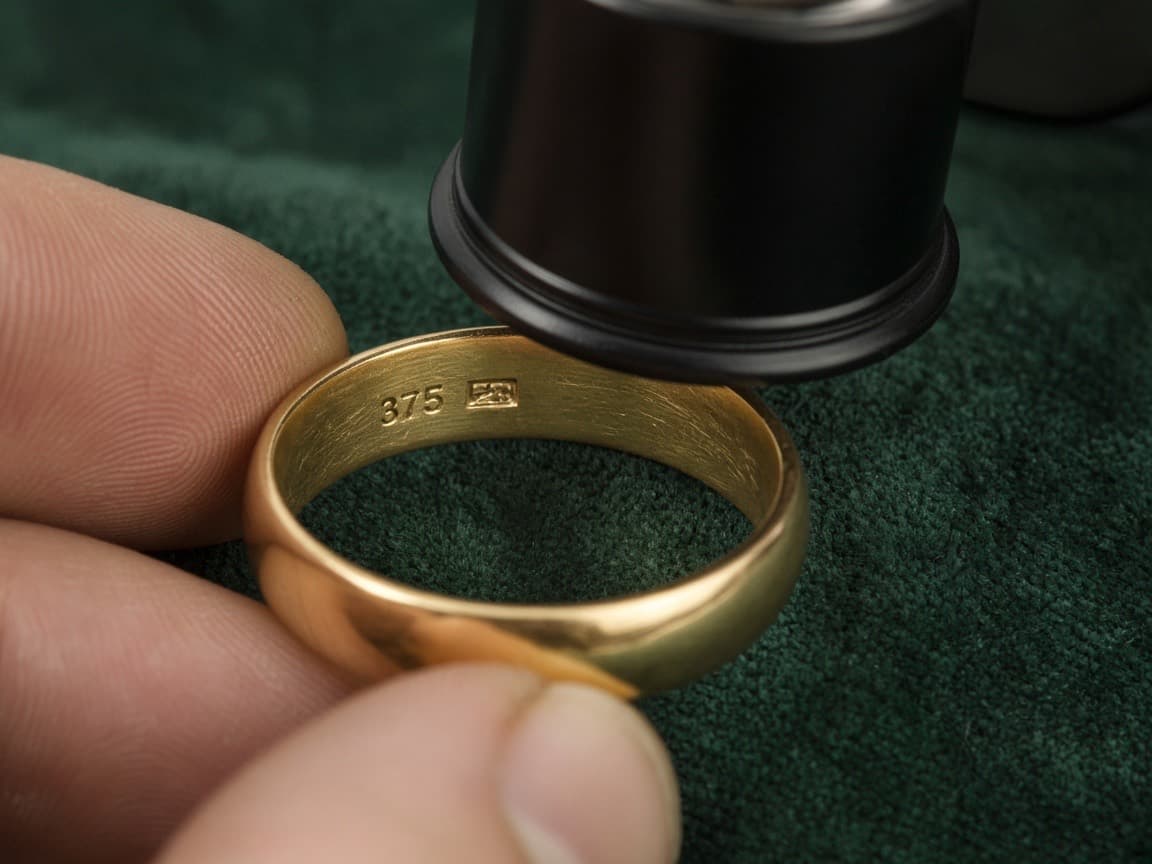
Hold the piece under good light and bring the loupe right up to your eye, then bring the piece up to the loupe. The mark is often smaller than a grain of rice.
- Ring
- Inside the band. Turn it and read right round; the mark is tiny.
- Chain or bracelet
- On the clasp, or on the small flat tag or ring right beside the clasp. Sometimes on the last link.
- Pendant or charm
- On the bail (the loop the chain runs through) or flat on the back.
- Earrings
- On the post, or stamped into the back of the butterfly or the hook.
- Brooch
- On the back, beside the pin or the catch.
- Watch
- Inside or on the case back. Plaqué, 20 microns, or a number with GP after it is plate: most gold-coloured watches are.
- Teapot, tray, jug, candlestick
- On the base, or in a line near the rim or the handle. Several small stamps in a row is the pattern you want.
- Cutlery
- On the back of the handle, near the end.
- Coin or bar
- On the face: 999, 999.9, Fine Gold, Fine Silver, with the weight.
Gold marks that are good
The number is the amount of gold in a thousand parts: 375 means 375 parts gold, which is 9ct. The K marks mean the same thing in carats. Each one tells you the row to read on the calculator.
- 375Good
9ct gold, the Irish and UK standard
9ct row on the calculator
- 9ctGood
9ct gold, also stamped 9K or 9kt
9ct row
- 585Good
14ct gold, also 583 on older pieces
14ct row
- 14KGood
14ct gold, the American and continental stamp
14ct row
- 750Good
18ct gold
18ct row
- 18KGood
18ct gold
18ct row
- 916Good
22ct gold, common on Asian and Middle Eastern jewellery
22ct row
- 22KGood
22ct gold
22ct row
- 999Good
24ct, pure gold: coins, bars and some Asian jewellery
24ct row
- 24KGood
24ct, pure gold
24ct row
Real gold, but ask us first
- 333Ask us first
8ct gold, the German low standard
Real gold, below our lowest row. WhatsApp us for a rate before you buy
- 417Ask us first
10ct gold, also stamped 10K: American
Real gold, between 9ct and 14ct. WhatsApp us for a rate before you buy
Silver marks that are good
925 and the word Sterling are what you will see most. The other numbers are real silver too, from other countries; the calculator has a row for each.
- 925Good
sterling silver, 92.5 percent
Sterling row on the calculator
- SterlingGood
sterling silver, also Ster, Stg or Sterling Silver
Sterling row
- 958Good
Britannia silver, better than sterling
Sterling row; we pay the extra at test
- 999Good
fine silver: bars, coins, some bangles
Fine silver row
- 950Good
French and Japanese first standard
Sterling row; we pay the extra at test
- 900Good
coin silver, 90 percent: old American and continental
Other silver row (800 to 900)
- 835Good
continental silver, 83.5 percent: Dutch, German, Austrian
Other silver row (800 to 900)
- 830Good
Scandinavian silver, 83 percent
Other silver row (800 to 900)
- 800Good
continental silver, 80 percent: German, Italian, Austrian
Other silver row (800 to 900)
Symbols that mean sterling silver
Older Irish and British silver carries little pictures instead of, or as well as, a number. These are struck by an assay office after the metal was tested, so they are the best marks a piece can have. You will usually see three or four small stamps in a row: a standard mark, a town mark, a date letter and the maker's initials.
Harp crowned
Irish sterling silver. The standard mark struck in Dublin since 1637.
Hibernia
A seated woman with a harp: the Dublin Assay Office mark. Sits beside the crowned harp.
Lion passant
A lion walking left: English sterling silver. On its own it is enough.
Thistle or lion rampant
Scottish sterling: a thistle (older) or a lion standing on its hind legs (since 1975).
Anchor
Birmingham Assay Office. The town mark; the lion beside it is the sterling mark.
Rose
Sheffield Assay Office since 1975; a crown before that. Town mark, look for the lion with it.
Leopard's head
London Assay Office. Town mark, look for the lion with it.
Castle
Edinburgh Assay Office. Town mark, with the thistle or lion rampant.
A symbol you do not recognise is not a reason to refuse: plenty of European silver carries a crescent and crown, a Minerva head or a boar's head. Treat it as unmarked, do the magnet and the acid, and send us a photo if it passes.
A stamp is a claim, not a test
Cheap fakes come stamped 750 and 925 too. The assay symbols above are hard to fake; a bare number is not. So a good mark gets a piece to step 2, it does not get it bought. On gold, always do the magnet and the acid. On silver, a clear mark from the list and a clean magnet check is enough; use the acid when the mark is missing, worn or odd.
Marks that mean no
These mean plated, filled, rolled or base metal: a skin of gold or silver so thin there is nothing to melt, or no precious metal at all. If any of them appears anywhere on a piece, hand it back, whatever else is stamped beside it. A carat mark with GP, GF or HGE after it is plate, not gold.
Looks like gold
- GPHand it back
gold plated: a skin of gold on base metal
Hand it back
- GEPHand it back
gold electroplated
Hand it back
- HGEHand it back
heavy gold electroplate: still plate
Hand it back
- GFHand it back
gold filled: a thicker skin, still worthless to melt
Hand it back
- 1/20 12K GFHand it back
the fraction gives it away: one part gold in twenty, bonded to brass
Hand it back
- RGPHand it back
rolled gold plate
Hand it back
- Rolled goldHand it back
a sheet of gold rolled onto base metal
Hand it back
- 18K GPHand it back
a carat with GP, GEP, HGE or GF after it is plate, not 18ct
Hand it back
- PlaquéHand it back
French for plated; Plaqué or, Plaqué G, 20 microns: common on watch cases
Hand it back
- DoubléHand it back
French and German rolled gold
Hand it back
- Gold toneHand it back
gold coloured, no gold in it
Hand it back
- GiltHand it back
gilded: a wash of gold over something else
Hand it back
- VermeilHand it back
sterling silver under a gold skin
Silver at most, never gold. Pay the silver row or hand it back
- PinchbeckHand it back
a brass that looks like gold, on antique pieces
Hand it back
Looks like silver
- EPNSHand it back
electroplated nickel silver: a silver skin on nickel
Hand it back
- EPHand it back
electroplated
Hand it back
- EPBMHand it back
electroplated Britannia metal: pewter under a silver skin
Hand it back
- A1Hand it back
a plating grade, not a silver standard
Hand it back
- Silver plateHand it back
plated, whatever else is stamped beside it
Hand it back
- Sheffield plateHand it back
copper with silver fused onto it
Hand it back
- Nickel silverHand it back
copper, nickel and zinc: no silver at all
Hand it back
- German silverHand it back
the same alloy as nickel silver
Hand it back
- AlpacaHand it back
nickel silver again, also Alpacca
Hand it back
- Britannia metalHand it back
a pewter: not Britannia silver, which is 958
Hand it back
- PewterHand it back
tin and antimony
Hand it back
- StainlessHand it back
steel; also Inox, Steel, Acier
Hand it back
- TungstenHand it back
a heavy grey metal sold as rings; titanium the same
Hand it back
- Silver toneHand it back
silver coloured, no silver in it
Hand it back
Try the magnet
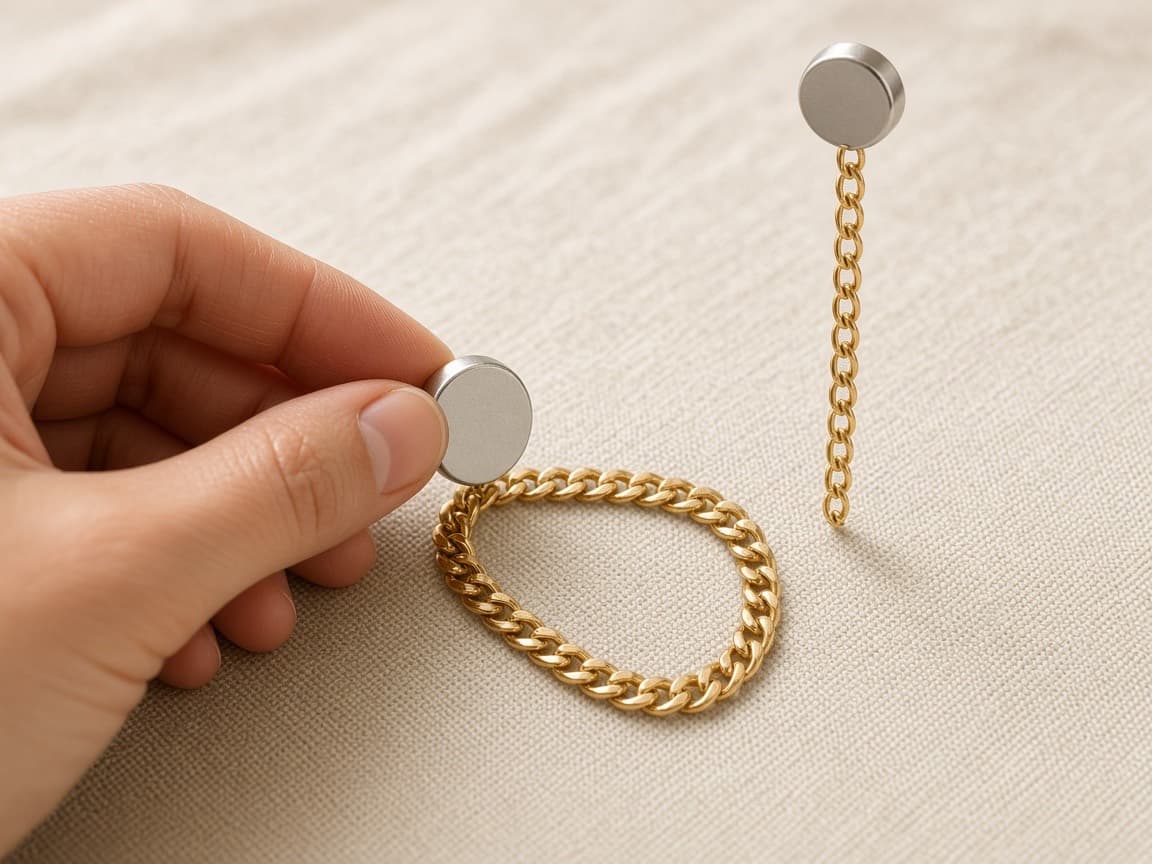
Gold and silver are not magnetic. Hold the magnet from the kit against the piece: if it pulls, even slightly, it is not solid gold or silver. Ten seconds, and it catches most of the fakes.
- Test the body of the piece, not the clasp. Hold the magnet against the links of a chain, the band of a ring, the back of a pendant, the bowl of a spoon. Lay a chain flat and bring the magnet down onto it.
- Any pull is a no. It does not have to leap at the magnet. If the piece drags, lifts or swings toward it, it has iron or steel in it and it is not what the stamp says.
- Clasps, springs and pins are often steel. That is normal on real gold and silver. If only the catch pulls, the piece can still be fine: test the rest of it, and the acid decides.
- No pull is not proof. Brass, copper, lead and most plated pieces do not pull either. A piece that passes the magnet goes on to the acid; it is not bought yet.
The acid test
The kit has four gold acids (9ct, 14ct, 18ct, 22ct) with a black touchstone, and one silver acid. The acid cannot be fooled by a stamp: it reacts with whatever the metal really is. Two minutes once you have done it a few times.
Gold: a streak on the stone
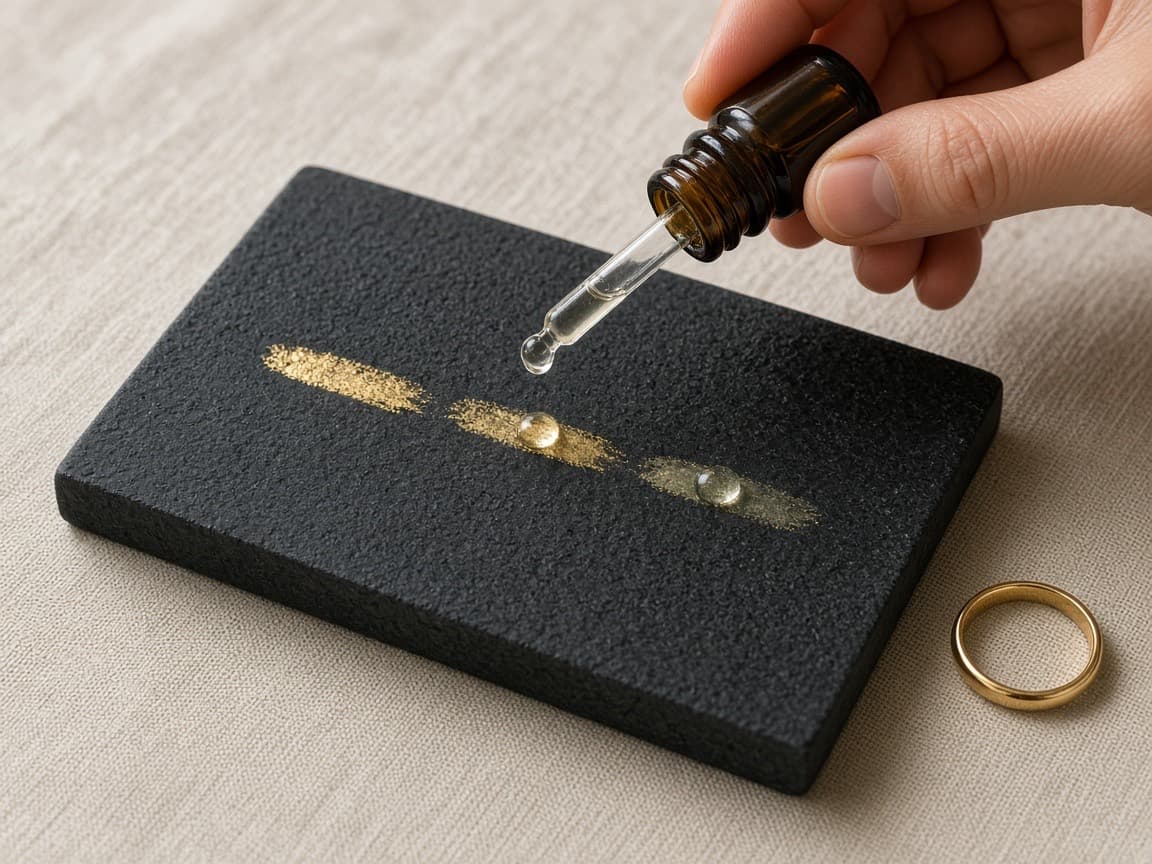
- Rub the piece on the touchstone, firmly, until you have a clear gold streak about a centimetre long. Rub hard enough to get through any plating; on a doubtful piece, rub an edge or the inside where the wear is.
- Pick the acid for the carat on the hallmark. A 750 piece gets the 18ct bottle. No hallmark, start with 9ct.
- One drop on the streak, then watch it for twenty seconds. Read the result off the table.
- Wipe the stone clean between pieces so streaks do not mix.
Streak stays bright
At least that carat. Try the next acid up to find the top.
Streak slowly dulls or fades
Below that carat. Try the next acid down and go by the one it survives.
Streak vanishes, fizzes, goes green or brown
Base metal or plate. Hand it back.
Streak turns milky white
Silver under a gold skin (vermeil). Silver at most, never gold.
The streak holding under the 9ct acid but fading under 14ct means it is 9ct: read the 9ct row. Holding under 18ct means 18ct. The acids only tell you a floor, so work up the bottles until one fades.
Silver: a notch, never the surface
Silver acid on the surface only tests the plating, and it leaves a black stain the seller will not thank you for. Get under the surface first.
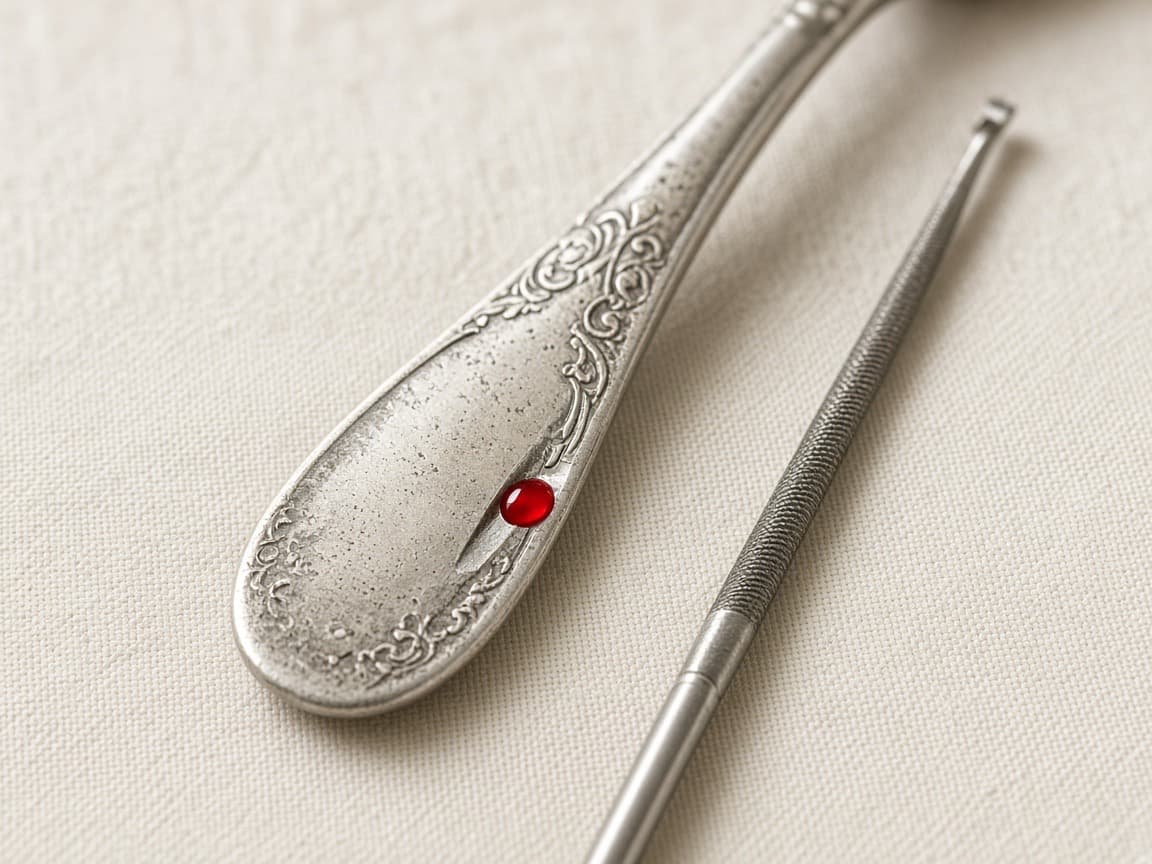
- Pick a hidden spot: inside a rim, under a foot, the back of a clasp, the underside of a handle.
- Cut a small notch with the needle file, deep enough to show bright metal underneath. On plate you will see a different colour appear as you file: that alone is your answer.
- One drop of silver acid in the notch. Read the colour straight away, then wipe it off: it keeps working if you leave it.
Bright red or dark red
Sterling, 925 or better. Buy on the sterling row.
Brown
A lower standard, around 800. Price it on the other silver row.
Green or blue
Base metal or plate. Hand it back.
Yellow
Lead or tin, often inside a weighted piece. Hand it back.
Things that are wrong before you test
None of these needs a loupe. Any one of them: slow down, test everything, and be ready to hand it back.
- Too light for its size. Gold is heavy; a big chain that weighs nothing is hollow or not gold.
- A different colour showing through at the edges, the clasp or the high points: pink, grey or dull yellow under the shine.
- Green or black marks on the seller's finger or neck where they wore it.
- A stamp that is crooked, too big, too shiny or looks added later.
- A handful of identical new pieces, or chains that look freshly cut.
- A price the seller names that is far below what the piece would be worth if real.
Buy or hand back
The whole page in one list. Work down it with the piece in your hand.
- 1
Is there a mark from the red list anywhere on it?
Yes: Hand it back.No: Carry on. - 2
Does the magnet pull on the body of the piece?
Yes: Hand it back.No: Carry on. - 3
Gold: does the streak hold under the acid for its carat?
Yes: Read that carat's row on the calculator.No: Try the next acid down. Nothing holds, or it goes green: hand it back. - 4
Silver: a clear mark from the green list, or a red drop in the notch?
Yes: Read the silver row on the calculator.No: Hand it back.
Passed everything? Weigh it, price it on the calculator and offer the seller less than the figure it shows. The difference is your margin.
Still not sure?
Do not buy it. Send us a photo instead.
A clear photo of the piece and of the mark, on WhatsApp, and we will tell you what we see while the seller is still at the counter. We would rather answer ten messages than see you lose money on one plated chain.
What happens if something gets through
Every parcel is weighed and XRF-tested on camera when it reaches us. Where the test disagrees with the stamp, the test decides. A piece that is plated, filled or base metal is not paid for and goes back to you, and what you paid the seller for it is gone.
- Checking the metal is your job, not ours. That is in the Buyer Programme Terms you sign when you join: anything bought that turns out not to be gold or silver is the shop's loss.
- Everyone misreads one hallmark. The first piece that fails our test is written off at your quoted price, up to the limit we agree with you in writing, once. After that the loss is yours.
- So the rule stands: three checks on every piece, and if any one says no, or you are not sure, hand it back. One plated piece bought at a gold price wipes out the margin on ten good ones.
About the buyer programme · Liffey Metals, Dublin. Independent and Irish owned.